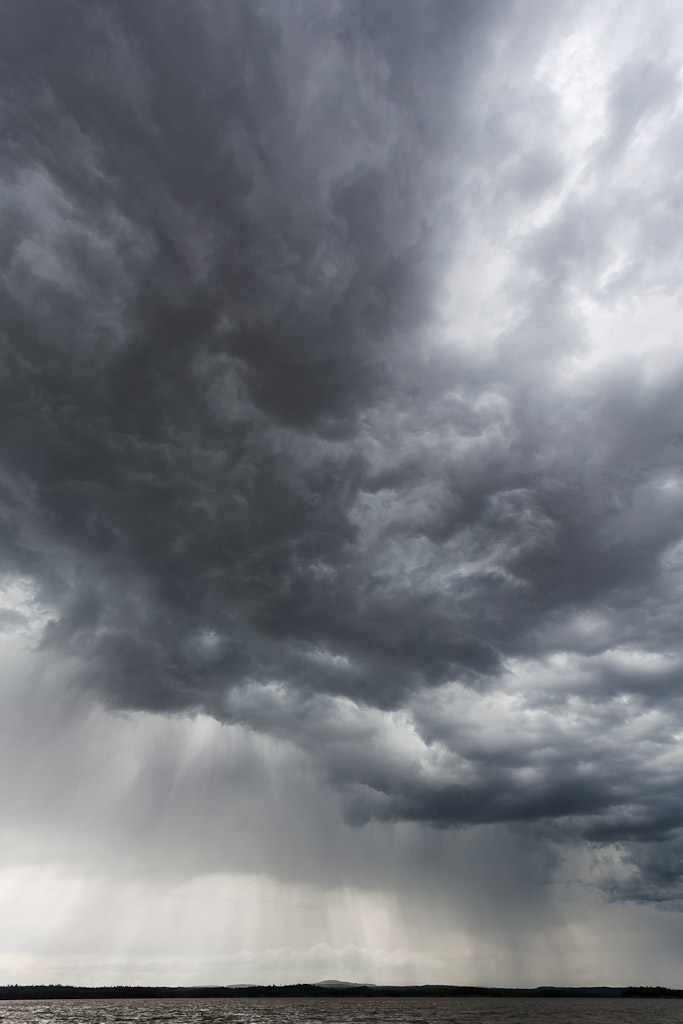
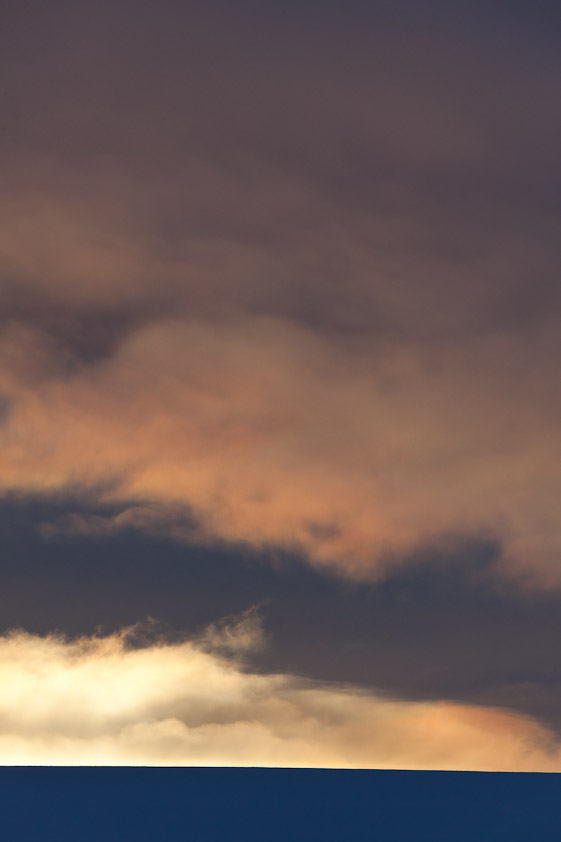
We had a terrific thunderstorm this afternoon in Edmonton, and the past couple nights as well—it’s easily one of my favourite things about summer in Alberta. So, I thought for my print today I would choose an image of a wicked summer storm that I had the pleasure of experiencing (and photographing extensively) last summer. This storm rolled in relatively slowly, or at least, I could see it coming for quite a while over the open sky of the Brazeau Resevoir (just south of Drayton Valley, Alberta). The texture of the underside of the cloud was amazing, and each minute it was more beautiful and scary than the last… until the very last minute… I was photographing from the beach, and after the first few big drops I ran (RAN) back to my truck a few hundred meters away, and was thoroughly soaked by the time I got there. But it was all worth it, of course. It rained so hard it wasn’t possible to drive away, but it didn’t last long and by the time it tapered off, I felt like taking just a few more photos…
Technically speaking, my favourite thing about how this print turned out is that I managed to hold the detail in the highlights in the upper-right corner of the cloud (yay!) If your monitor is reasonably accurate (most are not bad), and not set too bright (most are set way too high), you should be able to see faint wisps of cloud, even in the brightest parts.
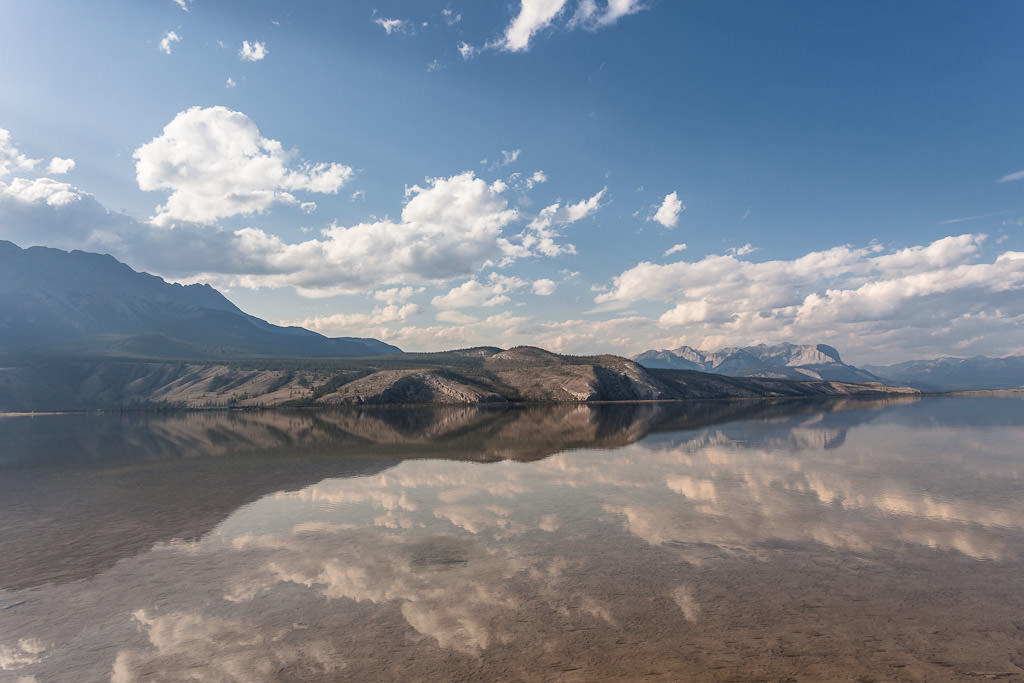
In August 2008 I was working for the Canadian Forest Service, doing research in pine stands west of Edmonton. I made this photo after leaving from work for the weekend and driving through Jasper on the way to a friend’s wedding in northern BC. I could see the light getting good as I got closer to the park and, after a speeding ticket in Edson (d-oh!), I had a terrific evening making many images that I was really happy with. This Daily Print project that I’m trying out is a great excuse to look back into my archives to find these images that I’ve kind of forgotten about. Watch for more photos from this August evening in the next few weeks…
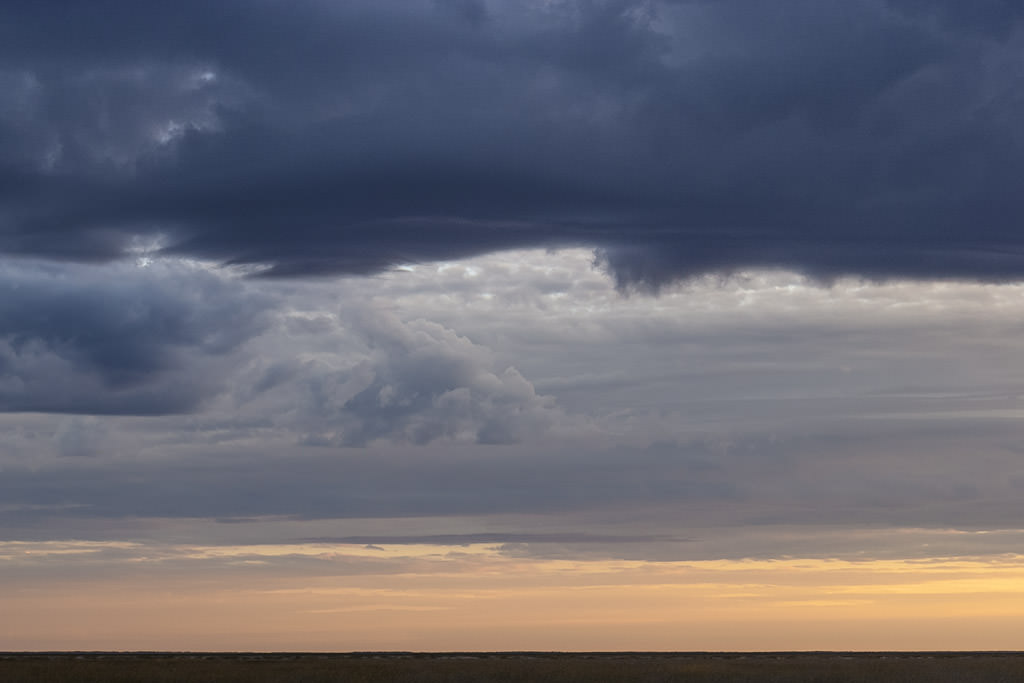
I made this photograph back in August of 2008 on a beautiful, calm morning at Beaverhill Lake but which didn’t last long—by mid-morning the clouds had completely rolled in, and I proceeded with getting soaked (all part of the experience).
I printed this photo today, as the first two prints (here and here) in my Daily Print project (explained here) were both highly-detailed, finely textured images with bold colours, so I thought I’d try something different, and a little out of the ordinary for me. It was interesting to see the finished print—the colours turned out great, but let’s say I need to practice printing more soft-textured images… (that’s what this whole exercise is about though, I guess, and I’m having fun doing it too)
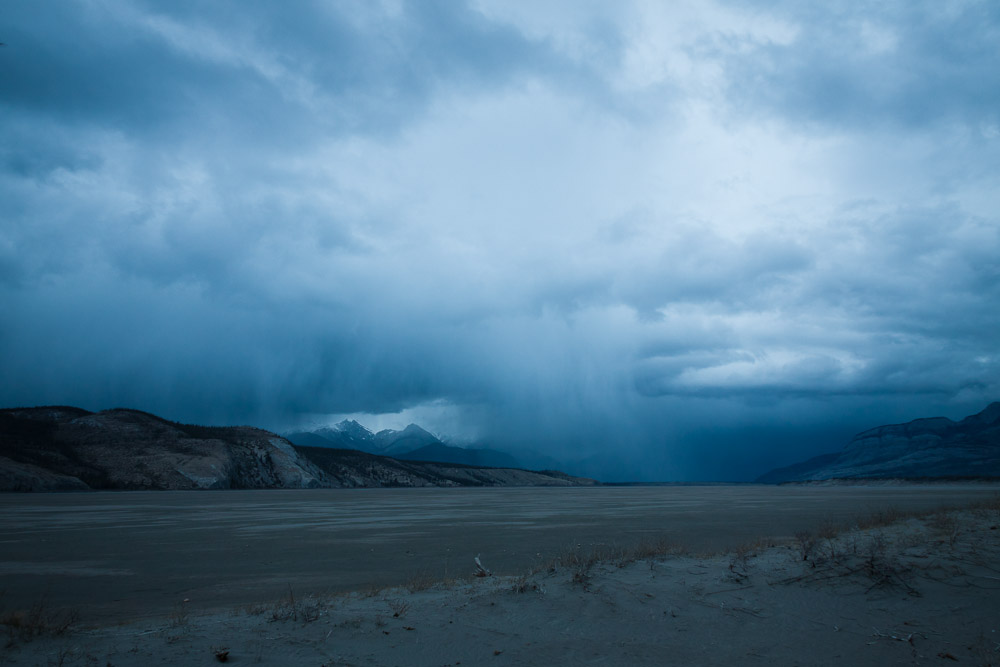
I recently had the chance to get away for a few days, and had the pleasure of being able to do some photography in Jasper National Park. The day that I took this photograph started out clear and sunny, and as the day went along these large clouds spilled out of the Athabasca River Valley to the west, coming east towards Pochahontas where I was staying. And while the clouds made it less appealing to sit out on the deck in the afternoon, they sure made for much more dramatic photographs later in the evening—well worth the trade-off.
I really like the contrast in this image of the heavy, wet sky and the falling rain streaking down—contrasted with the dry river flats still awaiting the melt of higher elevation snow and the start of spring and summer weather patterns.
I’ve been out conducting nocturnal owl surveys in south-central Alberta for the past few weeks, which has given me the chance to take some great sunset photographs, and to try out photographing at night—lots of fun (but lots to learn too!)
This photo came after a whole day of cloud that finally broke at just the right time to allow the setting sun to peek through. If they cooperate, a sky full of clouds sure makes for more interesting photography than a “perfectly” clear sky.
Here’s another photograph from the same outing to Wagner Natural Area as my last post. I like how the wispy-ness of the clouds contrasts the solid, high contrast forms of the snow-covered trees.
These are pretty classic Alberta winter clouds—high, thin, light diffusing layers without much definition (see this post that I wrote last winter). In this case though, I used a polarizing filter to darken the blue sky showing through these thin cirrus streaks, and that added enough contrast to show the delicate patterns of the cloud.
Here’s another short video clip that I took during this recent period of extremely cold weather. Walking over the footbridge between Strathcona Science Park and Rundle Park, I was mesmerized by the combined, overlapping movement of the fog rising from the river, the ice flowing downstream, and the ripples in the water. The light breeze was moving the mist around and the low sun was glinting off the thin icebergs, creating a beautiful, swirling, shining scene.