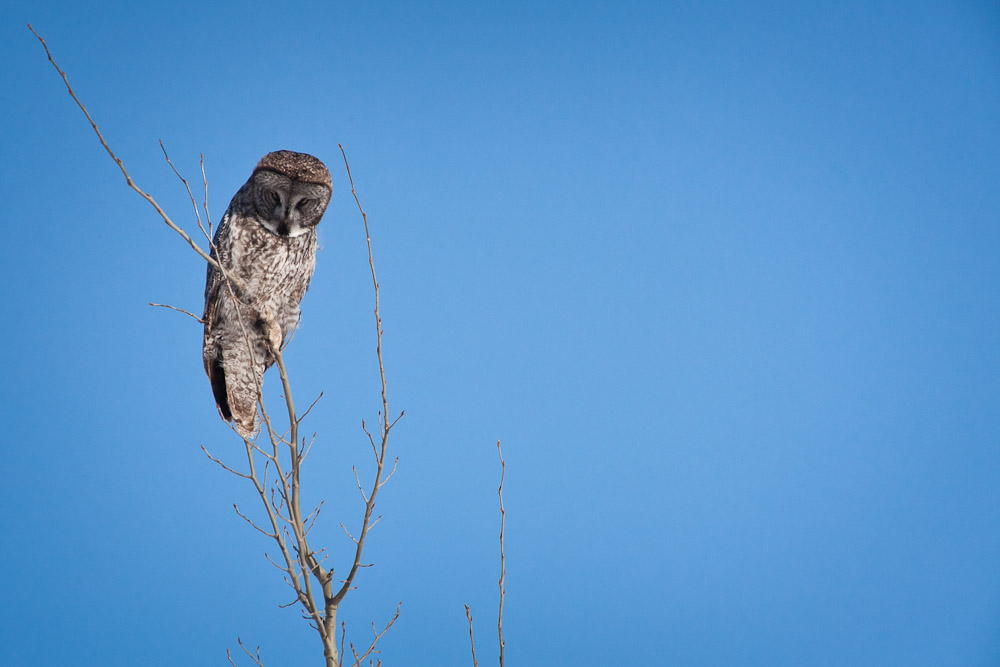
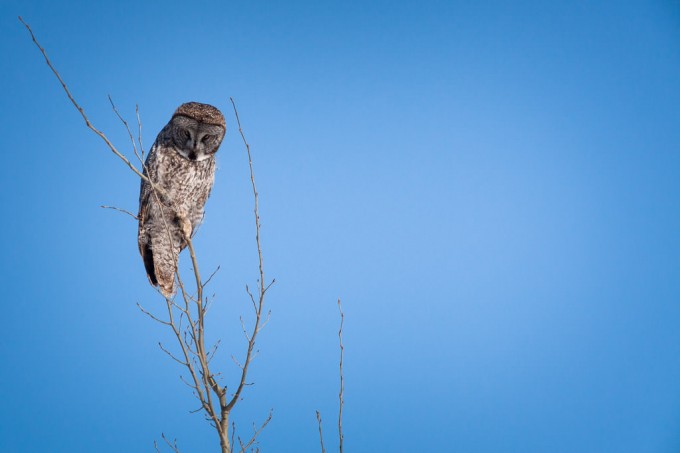
 Great grey owl hunting from thin aspen sapling I’ve written about this image before, and I wanted to print it today, as it’s got a very distinct separation between the sharp, in-focus owl and the completely blank sky where any grain or texture is purely an artifact of sensor noise and sharpening in post-processing. As I mentioned yesterday I tried the strategy of pushing the clarity and sharpening as far as I think looked good on my monitor, before backing off a bit. Yesterday the print came out looking really good (although it had a slight greenish cast that I hadn’t noticed on-screen), so I figured I’d try it on a much less forgiving photo today. We’ll see how it turns out…
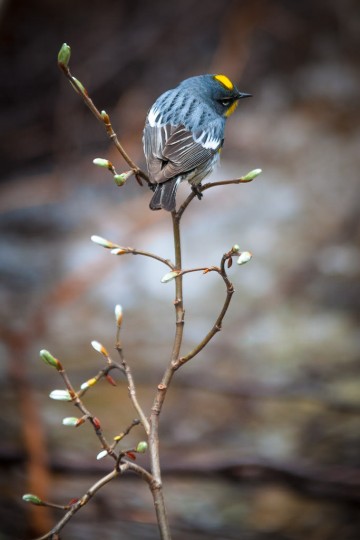 Yellow-rumped Warbler on budding willow I’ve always liked this photograph, and the memory of the day that I took it (which often confounds a photographer’s ability to tell if a photo’s any good or not). I’ve even written a post about this image before (which you can read here). Even so, I’ve never printed it, so I figured this Daily Print project was just the excuse I needed.
Bonus questions for this post: +1 point if you can tell me the sex of the bird, +5 points for the subspecies, and +50 points if you can tell me the age (hint: click the image to view it full size, and remember that this photo was taken in May…)
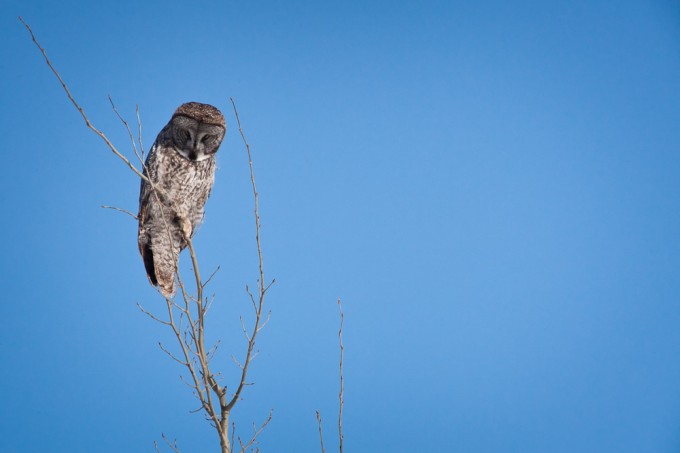 Great grey owl hunting from thin aspen sapling The photographs from my two previous posts were both taken while I was doing owl surveys and waiting for the sun to set (with camera at the ready, of course). So I thought I’d post an image of what we were out there looking for.
I don’t shoot a lot of wildlife, but I simply could not resist filling up a memory card while watching this owl hunt for rodents under the thick, spring snow. It was amazing to watch him (or her, I’m not sure) listening from the tops of these small aspen trees before swooping down and diving feet-first into the snow after his prey. I had the pleasure of watching from a distance for over an hour before he finally gave up, or got full, and slowly moved off.
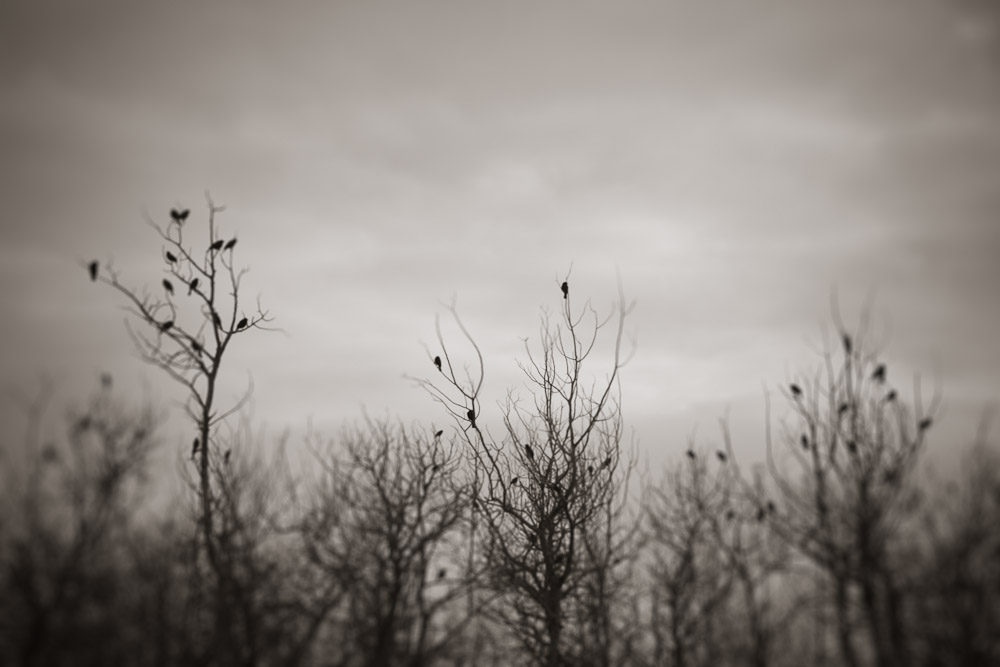
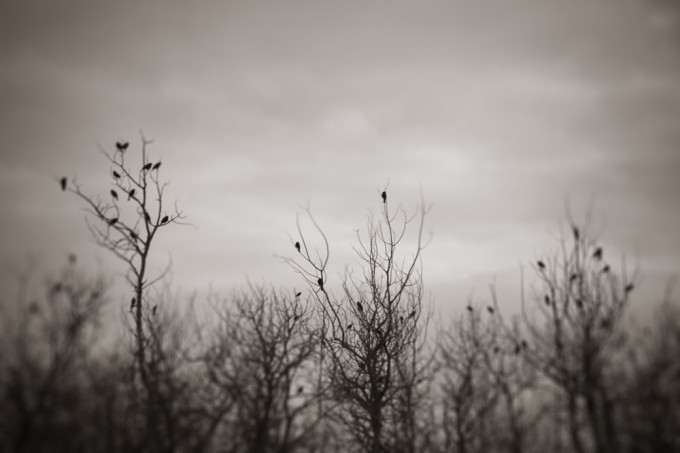 Blackbird flock in bare trees I recently received a request from a woman to use this photograph in a blog post she’s writing, which gave me the great excuse to re-visit this image and to share it here (it hasn’t made it into the new website yet, but watch for it in the Birds section of my catalogue, hopefully in the next few months).
I took this photo near the Beaverhill Bird Observatory near Tofield, AB in the spring of 2007. At the time, I was experimenting with defocusing images, or portions thereof, for creative effect. In this case, the original image was mostly sharp, and I “painted in” the blurred effect in post-processing. I was inspired to try this technique by another photographer who would create the same effect in the darkroom by spilling chemicals over the drying print and using a brush or sponge to blur the image.
It’s always fun to try new techniques, and although I haven’t taken many defocused photographs lately, you can view a selection of these images in my “Boreal Impressions” portfolio. I’d also recommend having a look at William Neill’s “Impressions of Light” portfolio for more great blurry images that were an inspiration to me (although he achieves the effect mostly through long shutter speeds and camera movement, rather than manually defocusing the lens).
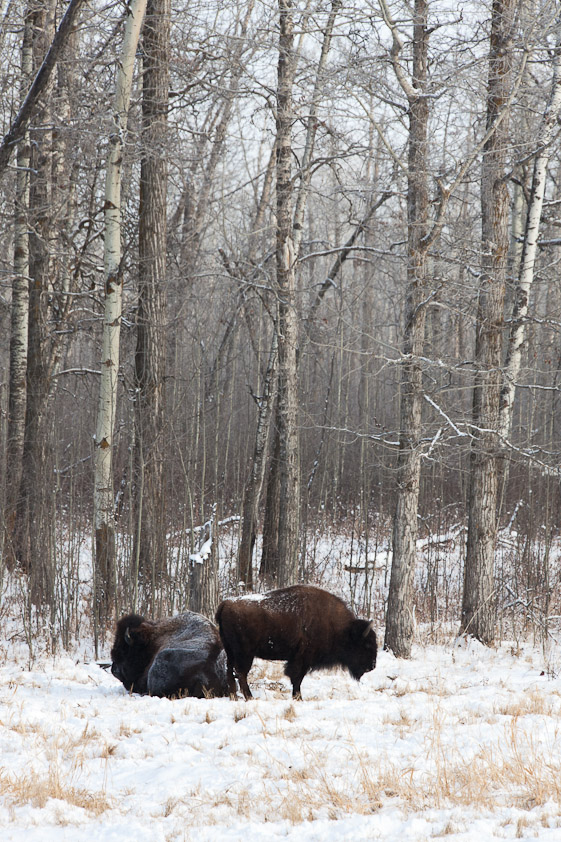
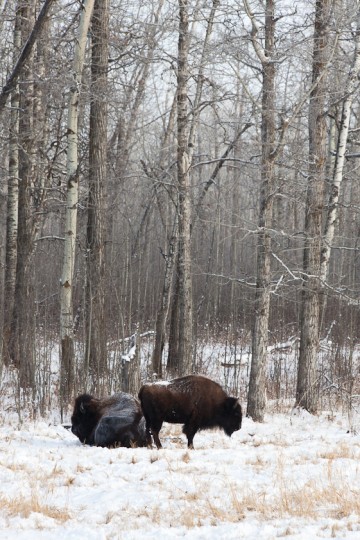 Resting winter bison It’s been a wintry couple of days in the Edmonton area, but these bison don’t seem to mind it. I took this photograph out at Elk Island Park recently, and I love how the fresh snow is just lying on top of the large bison. I had the good fortune of being able to watch a small herd slowly moving along and grazing through the snow for about an hour before they moved further off into the trees.
I made a lot of images of the herd, but I was surprised when I got home and could look at the photos large on my computer, how many times there were stray pieces of grass in front their faces—not necessarily ruining the shot, but definitely distracting. I guess it makes sense—the bison spent almost the entire time grazing with their heads just above the ground, and the dried grass was often over half a meter high. It’s just interesting how, while I was there, my brain could ignore the visual distractions, but at home, the light yellow-brown slashes against the deep, dark brown really stood out. Something to watch for next time…
P.S. I hope you like the “new and improved” larger in-post images starting with this entry. As always, you can click an image to view it full-screen. Enjoy!
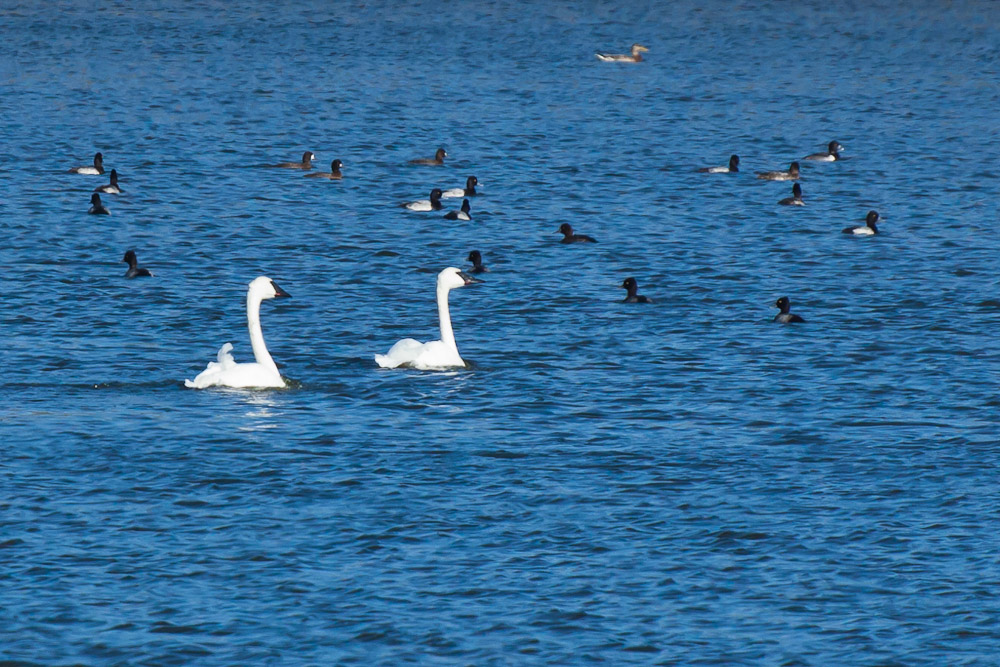
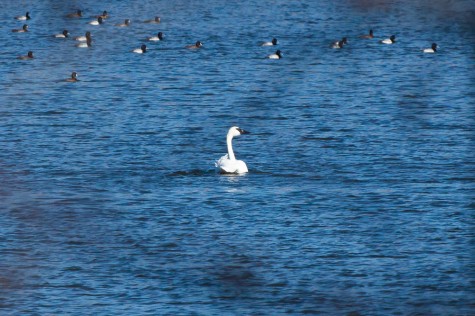 Trumpeter Swan at Ministik Lake 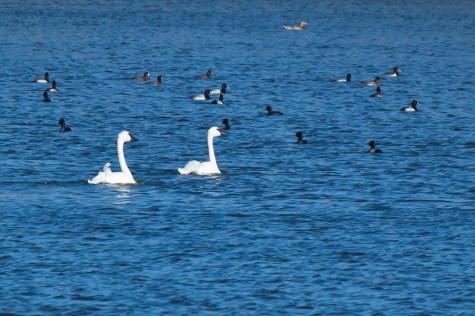 Trumpeter Swan Pair at Ministik Lake I was walking the Waskahegan Trail though the Ministik Lake Game Bird Sanctuary a couple days ago (Oct 5th, to be precise), and came across this pair of swans. While it’s fairly common to see migrating Tundra Swans flying (and honking) overhead in flocks this time of year, I am pretty sure these are the much less common Trumpeter Swan—but I would really appreciate if someone more familiar with Trumpeters could confirm (or contest) my ID. These two birds were on Bray Lake, right in the middle of the sanctuary, and were there when I first passed the lake, and still there later in the afternoon on my way back. This is what I love about Ministik—there’s always something new to see, you just have to get out there and look for it.
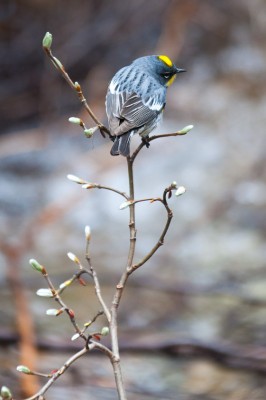 Yellow-rumped Warbler on budding willow I don’t normally photograph much wildlife (I don’t have the long lenses and patience usually required), but I couldn’t resist this little bird (a Yellow-rumped (or Audubon’s) Warbler) that I watched feeding along a small mountain stream for nearly a half hour. It was very early in the season and there had been a little snow overnight so the air was cool and damp, and the insects this bird was after were moving really slowly. He would perch on these willow saplings over the creek, turning his head to watch and then dart out to grab his meal from the air or the underside of a new leaf. It was a lot of fun to watch, and—employing the time honoured, fine-art, “shotgun” approach to composition—I filled up a good portion of my memory card trying to get just the right shot.
I know this photograph breaks a couple “golden rules” of composition—you’re not supposed to centre your subject (rule of thirds) or have the subject looking out of (rather than into) the frame. But I think it works this way (I even cropped in a little from a more “traditionally” framed shot). I think the shadowed area in the top-left balances the light, empty area at the bottom, and for me, the bird’s out-of-frame gaze gives a bit of the feeling that he’s just about to leave the frame himself (which in fact he did). Let me know what you think—just click below to add your thoughts. Thanks!
|
(Click photos to enlarge)
|